

Improved Investment Environment as a Real Factor in Solving Current Economic Problems


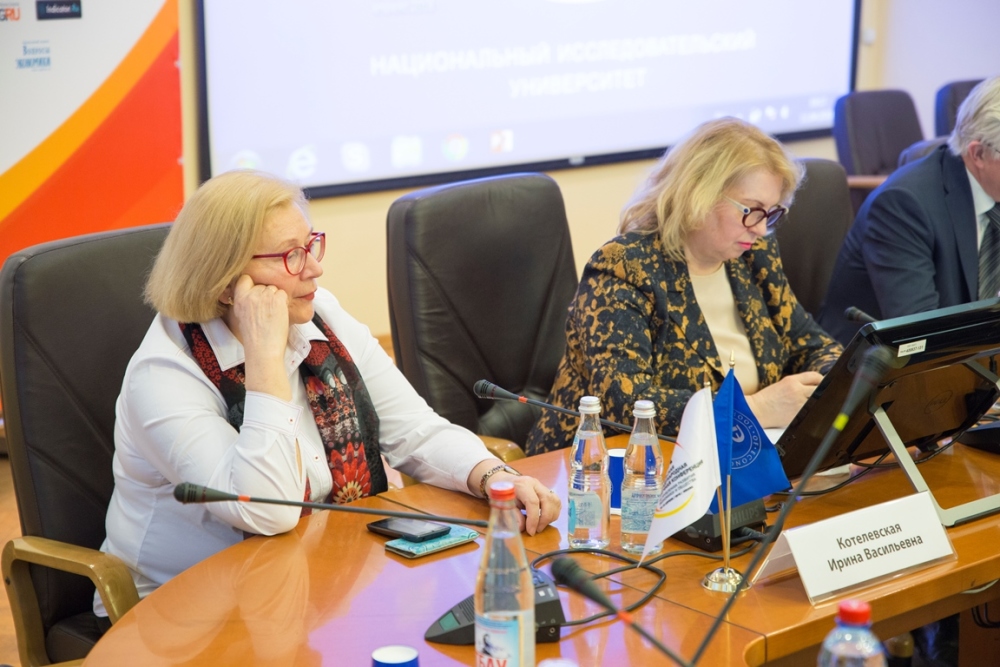


The subject of the risks and challenges related to sanctions on Russia is crucial in defining a number of different areas of economic policy. Participants in the round table focused on improving the business environment as one of the ways of responding to sanctions, exchanged opinions during the 19th April International Academic Conference on Economic and Social Development about how to move into positive economic growth while under this external pressure.
The time for pro-active policy has come
As President of the Russian Union of Industrialists and Entrepreneurs (RSPP) and HSE Alexander Shokhin noted, even if the international situation improves it is important to be prepared, since sanctions are a long-term mechanism that is not easy to revoke. As an historical example, he gave the Jackson-Vanik amendment, introduced due to limits on emigration from the USSR: it was only a quarter of a century after the USSR collapsed that it was possible to permanently exclude Russia from its implementation. ‘We need to take into account the fact that revoking sanctions will take significantly more time than adopting them,’ Shokhin said.
How can we overcome the impact of sanctions?
Of course, reciprocal action remains a possibility, and now people are proposing various different counter-sanctions, such as limiting the export of titanium or RD-180 rocket engines, ‘however, viewed objectively, these protective mechanisms could be seen as cutting off our nose to spite our face,’ the RSPP President said. He said that the expert community’s most pressing task is currently to act proactively not reactively. So rather than thinking about how to react to sanctions, we need to consider how to create the mechanisms and economic policy instruments that will help us minimize the impact of sanctions and ensure we are able to respond to the challenges that, as a country, we currently face.
One of these challenges, according to the President of the Russian Federation’s message to the Federal Assembly, is to achieve growth rates at least equal to the world average. Among the factors contributing to economic growth, the most important include increasing the share of investment in fixed capital (as a minimum 25% of GDP), investment which is rooted in private initiative, developing competition and entrepreneurship, and reducing the government share in the economy as an entrepreneur. ‘Improving the business environment is the main way of counteracting the negative impact of sanctions,’ Alexander Shokhin said. ‘And right now we don’t only need to ensure a positive pace of economic growth, we need to support an economic breakthrough.’
How to bring capital back to Russia and lead business out of the shadows
Professor at the Department of the Theory and Practice of Business-Government Interaction Igor Vdovin stressed that is important to note two key factors when looking at major improvements in the business environment: returning capital to Russia; and bringing Russian businesses out of the shadows. ‘I think that those people who have, or had, Russian citizenship, and who manage their money outside Russia should be considered foreign investors,’ Vdovin said. In this regard investment policy should appeal to them in efforts to attract foreign direct investment rather than treating them like criminals and fraudsters.
The expert presented international experience with capital amnesties, such as seen in Italy where from 2001-2002 they managed to return 61 billion Euros – citizens only had to pay a fee of 2.5% of the income earned or buy government bonds worth 12% of the value of the hidden assets. In Turkey in 1998, a similar procedure was applied to businesspeople with no stated requirements – other than returning the capital to the country. ‘Our lawmakers fantasise about the tariffs they can charge, the taxes to be paid, but we need to be informed by best practice,’ Vdovin said.
Other countries faced with similar conditions back small and medium sized business, and now is the time to send in the light cavalry and infantry, since it is more difficult to impose sanctions on them
As for drawing business out of the shadow economy, departmental research indicates that this involves a minimum of 30 different sectors employing millions of people. ‘Many businesspeople agree that this is a difficult position to be in, but that the transition to the ‘green’ zone is associated with significant risk, entailing full checks of the business people’s history of operations’ Vdovin noted. All these checks by various different agencies could mean that fewer people will want to run businesses or invest money. So here the focus is on the survival rate of business as a whole, and it is vital to create comfortable conditions both for those who have not yet left the country and for those who need to return to Russia. This apposite and complex challenge involves developing legal tools to regulate the transition of businesses from the ‘grey’ to the ‘green’ zones.
Small business – big problems
As Chairman of the Board of Trustees at Opora Rossii (a nationwide association for SMEs) and Professor of the HSE Department of the Theory and Practice of Business-Government Interaction Sergey Borisov said, other countries faced with similar conditions back small and medium sized business, and now is the time to send in the light cavalry and infantry, since it is more difficult to impose sanctions on them.
The situation regarding the development of small business in Russia is complex. Today, there are approximately 6 million 100,000 small business entities registered in Russia. Growth varies from 1% to 1.5%, and for a long time their contribution to GDP has been stable at 20%-21%, and their employment rate is unchanged at 25%.
The HSE professor identified several reasons for small business not being seen as an economic driver: management decisions are developed not by entrepreneurs but by officials, government support covers just 2%-3% of small business, and entrepreneurs meanwhile face a host of unnecessary and draining checks, regional authorities are more interested in subsidies than in growing SMEs.
Sergei Borisov also pointed to low skills as a serious problem, in particular regarding the lack of any clear and comprehensive training programmes in entrepreneurship. As for solving these problems, the HSE professor again drew on international expertise: all regulatory activity to support entrepreneurship in Europe is based on simple principles of legality, banning the abuse of the law, prohibiting meaningless application of the law, proportionality, and banning excessive formality.
Banks and the quality of the business environment
CEO of International Trade and Integration, HSE Professor Vladimir Salamatov said that one of the key solutions to these economic issues is improving the conditions under which international economic activity takes place. ‘According to research, exporters develop better than anyone,’ Salamatov said. ‘And those that are strongest are those that also import technology and components, those that participate in global trade.’
More complex external environment is no reason to withdraw from market principles and a number of transformations
As Deputy Chairman of the Board at Alfa Bank, HSE Professor Vladimir Senin said, the question of improving the business environment is not only relevant in the context of sanctions, but is important for the Russian economy as a whole. He feels that without sustainably functioning banks it is impossible to ensure the appropriate quality of business environment. One of the most important functions of the financial sector is to support investment. Vladimir Senin noted that in Q1 2018, capital outflow from the private sector amounted to 13.4 billion USD (by comparison the previous year it was 16.4 billion USD). The volume of foreign direct investment in 2017 amounted to just 20 billion USD (4 years previously this amounted to 70 billion USD). In response to the question of where to find this investment, Vladimir Senin agreed with his colleagues that one important measure would be returning capital that left the country.
In conclusion, the HSE professor noted that the more challenging external environment is no reason to withdraw from market principles and numerous transformations. ‘For the banks and financial markets the issue of improving the business climate means reducing the regulatory burden, increasingly the flexibility of regulation, protecting competition and property,’ Vladimir Senin said.

See also:

HSE Researchers Compile Scientific Database for Studying Children’s Eating Habits
The database created at HSE University can serve as a foundation for studying children’s eating habits. This is outlined in the study ‘The Influence of Age, Gender, and Social-Role Factors on Children’s Compliance with Age-Based Nutritional Norms: An Experimental Study Using the Dish-I-Wish Web Application.’ The work has been carried out as part of the HSE Basic Research Programme and was presented at the XXVI April International Academic Conference named after Evgeny Yasin.
China Bets on Expanding Leading Universities, Postgraduate Education, and STEM Fields
At the XXVI April International Academic Conference named after Evgeny Yasin at HSE University, one of the distinguished speakers was Prof. Liguo Li of the School of Education at Tsinghua University. He spoke about changes in the structure of higher education in China in line with national strategic priorities, including a proposed 1.7–2-fold increase in the number of leading research universities.
Scholar Explains How States Can Build Governance in Era of Mega-Shifts
How can states maintain governability and stability in a world where established rules are rapidly losing their force? Prof. Ali Farazmand of Florida Atlantic University answered this question in a presentation delivered at the XXVI April International Academic Conference named after Evgeny Yasin. The scholar proposed examining the transformation of the global order through the lens of two ‘mega-shifts’—from the rise of global corporate capitalism to the emerging multipolarity of today—and demonstrated why this transition between eras requires fundamentally new approaches to governance.
Supercomputers as Superheroes: How High-Performance Computing Is Saving the World
Modern supercomputers can perform more than a trillion calculations per second. This immense capacity enables researchers to address problems that were previously intractable. At the XXVI April International Academic Conference, Ilias Kotsireas, a professor at Wilfrid Laurier University, spoke about the potential of high-performance computing in fields such as weather and climate modelling, astrophysics, and medicine.
A Time for Flexible Solutions: How China Trains In-Demand Specialists
Building an effective workforce training system requires not only appropriate institutions, but also well-developed intermediary organisations capable of translating policy into practice and connecting different groups of stakeholders, said Dr Po Yang, Professor at Peking University. She was an invited speaker at the XXVI April International Academic Conference named after Evgeny Yasin.
XXVI April International Academic Conference Kicks Off at HSE University
The conference programme covers five research topics: economics; human capital and society; instrumental methods and models; foresight research; and international research. Hundreds of scientists from around the world will take part in the conference.
Applications for Participation in XXVI April International Academic Conference Still Open
Applications can be submitted on the conference website until December 16, 2025. The programme has been developed around five research themes: Economics, Human Capital and Society, Instrumental Methods and Models, Foresight Research, and International Research. The heads of these areas have presented, in video format, the priority topics and sections for which they are expecting submissions.
Applications to Participate in April International Academic Conference Now Open
HSE University is now accepting proposals to present academic reports at the XXVI April International Academic Conference named after Evgeny Yasin. Applications can be submitted until December 16, 2025. The conference events will take place mainly on-site in Moscow from April 14 to 17, 2026.
24 Countries Represented at 25th Yasin International Academic Conference Held by HSE University
The Programme Committee of the 25th Yasin (April) International Academic Conference on Economic and Social Development has summed up the initial results. In 2025, 1,384 people from 24 countries and 29 Russian regions participated in the conference, with 335 of them delivering presentations.
Stuck in the Net: How Much Time Children Spend Online
On average, a schoolchild spends 48 hours a week on studies—equivalent to a six-day working week for an adult. This was highlighted by experts at the round table ‘Domains of Children’s Well-Being Evaluation for Human Potential and Evidence-Based Social Policy Development,’ held as part of the 25th Yasin (April) International Academic Conference.