

How Bilingual Brains Work: Cross-language Interplay and an Integrated Lexicon

An international team of researchers led by scientists from the HSE University have examined the interplay of languages in the brains of bilinguals. Using EEG data of Russian-English bilinguals, the authors were the first to demonstrate nearly instant and automatic detection of semantic similarity between words belonging to their two languages, suggesting the existence of an integrated bilingual lexicon in which words are activated in parallel in both languages. The study findings are published in Cortex.
Bilingualism is a widespread phenomenon of growing importance in today's world of globalisation and migration. In the broader sense, bilinguals are people who are able to communicate in two languages. Bilinguals can be 'balanced' or 'non-balanced' depending on the level of language proficiency, and 'early' or 'late' depending on the age of second language acquisition.
An increasing number of studies focus on non-balanced late bilingualism, since most bilinguals belong to this group. The questions of whether bilinguals access the lexicon of each language separately, whether their brains have formed an integrated bilingual lexicon, and how fast they are able to process linguistic information in their second language are widely discussed in research.
Previous research reveals that monolinguals have fast and automatic lexico-semantic access to their language. EEG captures the brain's response to a linguistic stimulus after 50 ms, meaning that a person takes just 0.05 seconds to recall and say the right word. An international team of researchers with the participation of scientists from the HSE Institute for Cognitive Neuroscience have examined whether 'late' bilinguals are able to process lexico-semantic information as fast and whether it involves parallel activation of the other language.
The authors asked 17 HSE University students, native speakers of Russian, to complete a task that involved semantic priming, ie, the mind's tendency to recognise a word faster if it is preceded by a similar one. In bilingual experiments, primes used are usually first- or second-language words which are similar in meaning, sound or spelling to the target word. In most cases, primes are masked so that subjects are not consciously aware of them. In this experiment, Russian words were presented as primes of English targets in conditions of semantic similarity or dissimilarity between the two languages. Stimuli were presented on a computer screen as a sequence: a cross in the middle of the screen to focus on, a series of % symbols as the forward mask, a prime presented for 50 ms followed by a target word, and the backward mask. The subjects were finally presented with a catch word and asked whether it was the same as the preceding target word. Since masks were used and the prime was shown for a very brief period, the prime’s effect on the perception of the target word was subliminal.
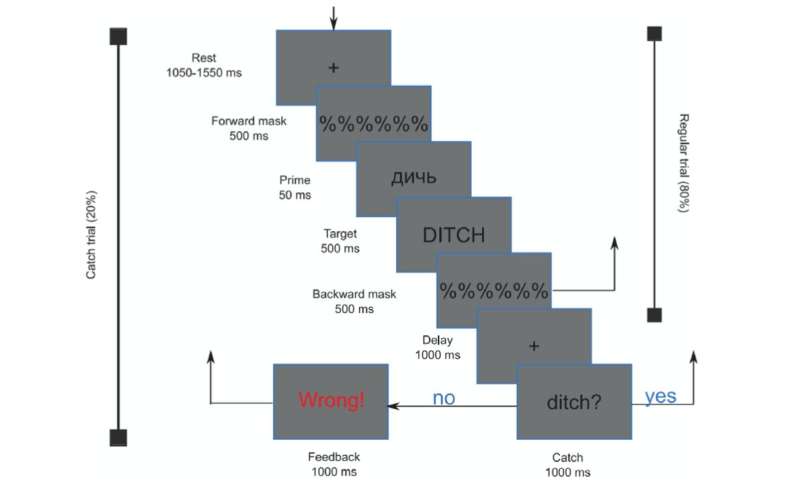
The authors recorded the subjects' EEG throughout the experimental session. An amplitude difference was registered at 40–60 ms, which is the earliest crosslinguistic effect reported so far.

Federico Gallo, study co-author, Junior Research Fellow of the HSE Institute for Cognitive Neuroscience
'Our findings confirm the existence of an integrated brain network for the bilingual lexicon. In this experiment, Russian primes, similar semantically to the English targets, made it easier for subjects to understand foreign words and shortened their reaction times. Our results suggest that second-language words are activated automatically in bilingual brains, and that cross-language interplay involves left temporo-parietal neural regions.'
However, according to Gallo, although having great temporal resolution, EEG has intrinsic limits when it comes to high-resolution spatial localisation. In the future, the use of MRI or MEG techniques could lead to fundamental discoveries in this area, adding a fine-grained spatial localisation of the phenomena observed in this investigation to the detailed description of their time-course.

Federico Gallo
Junior Research Fellow, Centre for Cognition & Decision Making
See also:

Scientists Reveal How Language Supports Complex Cognitive Processing in the Brain
Valeria Vinogradova, a researcher at HSE University, together with British colleagues, studied how language proficiency affects cognitive processing in deaf adults. The study showed that higher language proficiency—regardless of whether the language is signed or spoken—is associated with higher activity and stronger functional connectivity within the brain network responsible for cognitive task performance. The findings have been published in Cerebral Cortex.
Scientists Show That Peer Influence Can Be as Effective as Expert Advice
Eating habits can be shaped not only by the authority of medical experts but also through ordinary conversations among friends. Researchers at HSE University have shown that advice from peers to reduce sugar consumption is just as effective as advice from experts. The study's findings have been published in Frontiers in Nutrition.
HSE Scientists Uncover How Authoritativeness Shapes Trust
Researchers at the HSE Institute for Cognitive Neuroscience have studied how the brain responds to audio deepfakes—realistic fake speech recordings created using AI. The study shows that people tend to trust the current opinion of an authoritative speaker even when new statements contradict the speaker’s previous position. This effect also occurs when the statement conflicts with the listener’s internal attitudes. The research has been published in the journal NeuroImage.
Language Mapping in the Operating Room: HSE Neurolinguists Assist Surgeons in Complex Brain Surgery
Researchers from the HSE Center for Language and Brain took part in brain surgery on a patient who had been seriously wounded in the SMO. A shell fragment approximately five centimetres long entered through the eye socket, penetrated the cranial cavity, and became lodged in the brain, piercing the temporal lobe responsible for language. Surgeons at the Burdenko Main Military Clinical Hospital removed the foreign object while the patient remained conscious. During the operation, neurolinguists conducted language tests to ensure that language function was preserved.
HSE Scientists Use MEG for Precise Language Mapping in the Brain
Scientists at the HSE Centre for Language and Brain have demonstrated a more accurate way to identify the boundaries of language regions in the brain. They used magnetoencephalography (MEG) together with a sentence-completion task, which activates language areas and reveals their functioning in real time. This approach can help clinicians plan surgeries more effectively and improve diagnostic accuracy in cases where fMRI is not the optimal method. The study has been published in the European Journal of Neuroscience.
Researchers Identify Link between Bilingualism and Cognitive Efficiency
An international team of researchers, including scholars from HSE University, has discovered that knowledge of a foreign language can improve memory performance and increase automaticity when solving complex tasks. The higher a person’s language proficiency, the stronger the effect. The results have been published in the journal Brain and Cognition.
‘Engagement in the Scientific Process’: HSE Launches Master’s Programme in Neurobiology
The HSE University Academic Council has elected to launch a new Master's programme in Neurobiology for students majoring in Biology. Students of the programme will have access to unique equipment and research groups, providing them with the knowledge and experience to pursue careers in science, medicine and pharmacy, IT and neurotechnology, and education and HR services.
Scientists Discover That the Brain Responds to Others’ Actions as if They Were Its Own
When we watch someone move their finger, our brain doesn’t remain passive. Research conducted by scientists from HSE University and Lausanne University Hospital shows that observing movement activates the motor cortex as if we were performing the action ourselves—while simultaneously ‘silencing’ unnecessary muscles. The findings were published in Scientific Reports.
Russian Scientists Investigate Age-Related Differences in Brain Damage Volume Following Childhood Stroke
A team of Russian scientists and clinicians, including Sofya Kulikova from HSE University in Perm, compared the extent and characteristics of brain damage in children who experienced a stroke either within the first four weeks of life or before the age of two. The researchers found that the younger the child, the more extensive the brain damage—particularly in the frontal and parietal lobes, which are responsible for movement, language, and thinking. The study, published in Neuroscience and Behavioral Physiology, provides insights into how age can influence the nature and extent of brain lesions and lays the groundwork for developing personalised rehabilitation programmes for children who experience a stroke early in life.
Scientists Uncover Why Consumers Are Reluctant to Pay for Sugar-Free Products
Researchers at the HSE Institute for Cognitive Neuroscience have investigated how 'sugar-free' labelling affects consumers’ willingness to pay for such products. It was found that the label has little impact on the products’ appeal due to a trade-off between sweetness and healthiness: on the one hand, the label can deter consumers by implying an inferior taste, while on the other, it signals potential health benefits. The study findings have been published in Frontiers in Nutrition.