

Biologists at HSE University Warn of Potential Errors in MicroRNA Overexpression Method
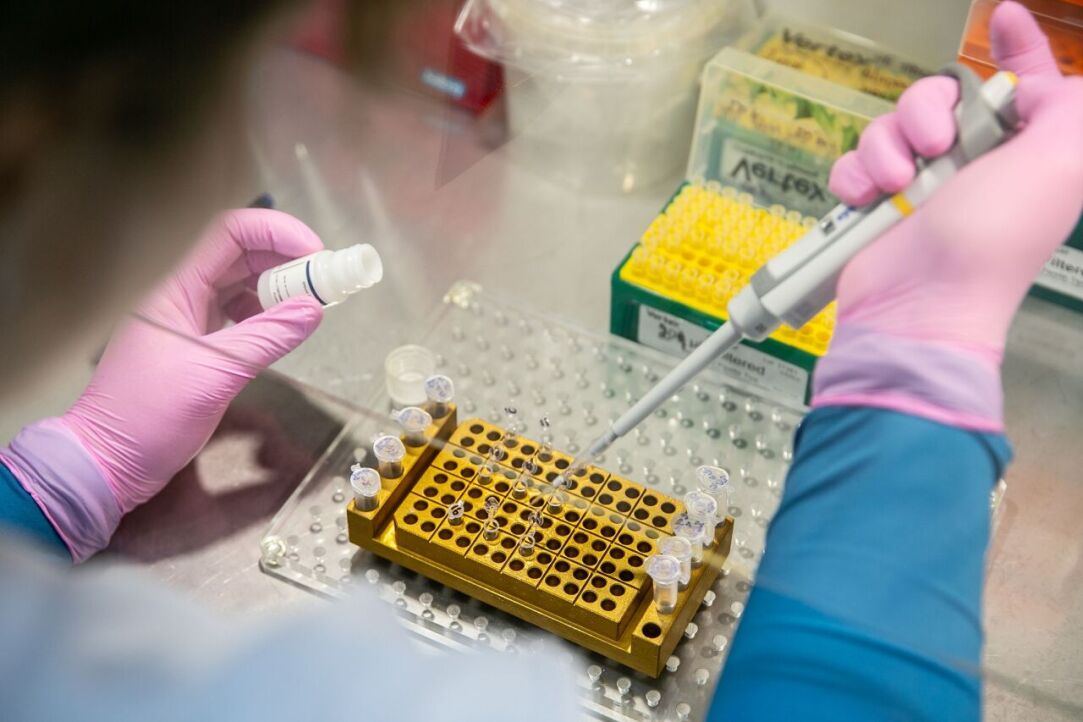
Researchers at HSE University and the RAS Institute of Bioorganic Chemistry have discovered that a common method of studying genes, which relies on the overexpression of microRNAs, can produce inaccurate results. This method is widely used in the study of various pathologies, in particular cancers. Errors in experiments can lead to incorrect conclusions, affecting the diagnosis and treatment of the disease. The study findings have been published in BBA.
The work of a researcher involves not only continuous pursuit of new discoveries but also careful attention to conventional, established knowledge. Sometimes, reliable and seemingly proven methods have characteristics that were previously overlooked.
A group of researchers led by Alexander Tonevitsky, Dean of the Faculty of Biology and Biotechnology at HSE University, have discovered such characteristics in the microRNA overexpression method. The scientists found that, in some cases, the results of experiments using this method may be incorrect, and these errors are very difficult to detect.
MicroRNAs (miRNAs) are small RNA molecules, approximately 20 to 25 nucleotides in length. They play an important role in regulating gene expression by determining how much protein will be synthesised in a cell from a specific molecule of messenger RNA (mRNA). This regulation is facilitated by a short fragment within the miRNA, which can bind to the target mRNA molecule if it finds a reverse complement (biologically compatible) sequence. When this occurs, protein synthesis from the mRNA is halted, leading to a decrease in gene expression.
As diseases, including cancers, progress, changes in microRNA expression levels are observed. Specifically, in prostate cancer, the number of miR-93-5p microRNAs increases, and higher levels of their expression are associated with greater aggressiveness of the disease. By significantly increasing the number of miRNA in laboratory cells, researchers can gain a clearer understanding of the processes associated with elevated expression of this miRNA.
A common approach for miRNA overexpression involves initially increasing the amount of precursor RNA in cells—a longer molecule from which miRNA is subsequently generated through cleavage by the Dicer enzyme. This is a natural process for the cell. However, the sequence of miRNAs formed as a result depends on how accurately the Dicer enzyme cleaves the precursor molecule.
The authors of the paper studied how the Dicer enzyme cleaves the molecule. They encoded the desired sequence in the precursor molecule, anticipating that Dicer would accurately cleave it as intended. However, it turned out that Dicer does not always operate as scientists expect. The enzyme primarily functions like a molecular ruler, consistently measuring a length of 22 nucleotides. During the synthesis of the precursor molecule, one or more uracils (a nucleotide base unique to RNA) are typically added to the end of the sequence. As a result, if a given miRNA sequence is longer than 19 nucleotides, the added uracils cause Dicer to cleave the molecule at an unintended location. This shift leads to the formation of miRNA isoforms.
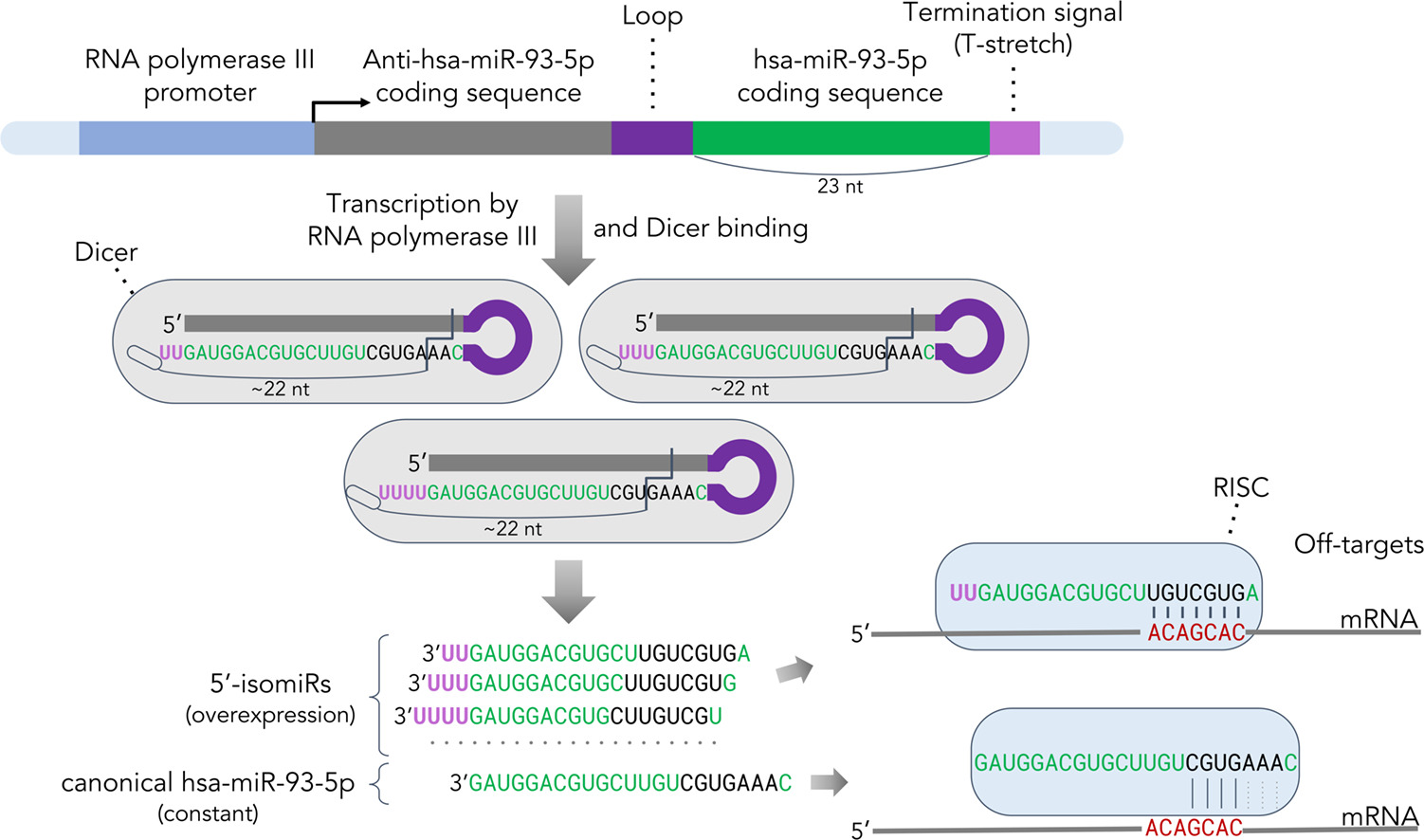
To investigate the cause of the shift in cleavage position of the precursor molecule, the scientists experimentally set several miRNA sequences of varying lengths, including a 23-nucleotide chain corresponding to the miR-93-5p miRNA. Using sequencing—a method that fully deciphers the nucleotide sequence of RNA or DNA molecules—the scientists observed that the added uracils in chains longer than 19 nucleotides cause a shift in the cleavage position.

Diana Maltseva
The formation of miR-93-5p miRNA isoforms resulted in a decrease in the expression of the HMGA1 gene, which plays a role in disrupting genetic information transmission during cell division and in regulating gene expression. However, HMGA1 was not the target of the standard form of miR-93-5p. Without knowledge of miRNA isoform formation, one might draw incorrect conclusions about the molecular mechanisms of the studied miRNA in prostate cancer.
'Isoforms may target the wrong mRNA molecules instead of those intended in the experiment, leading to the suppression of unintended genes. Understanding this peculiarity is crucial for both basic research and medical applications,' according to Diana Maltseva, Head of the International Laboratory of Microphysiological Systems at HSE University.
Scientists worldwide use the miRNA overexpression method in their experiments. Typically, the accuracy of the results is verified using polymerase chain reaction (PCR). However, this method was not sufficiently sensitive in this case.
'Our study has shown that only sequencing can reveal the shift in the cleavage position. Unfortunately, sequencing is a relatively expensive method, and not all laboratories can afford it. Therefore, it is crucial to develop new methods for miRNA overexpression and to design experiments carefully,' Maltseva comments.

See also:

Scientists Propose Method for More Efficient Resource Use in Machine Learning
An international group of researchers, including mathematicians from the AI and Digital Science Institute at the HSE Faculty of Computer Science, has provided a theoretical justification for a simple and computationally efficient method of estimating uncertainty in Stochastic Gradient Descent (SGD). The paper has been published on the scientific preprint server arXiv.org and presented at AISTATS 2026.
Team Success: Aligning Means with Objectives
In corporations, sports, and academia, people often face challenges they cannot handle alone. In such cases, selecting the right team is crucial. Tatiana Mayskaya, Associate Professor at the HSE Faculty of Economic Sciences and the International College of Economics and Finance, together with colleagues from foreign universities, examined team characteristics and found that less diverse teams are better suited to objectives where a high average performance is important, whereas more diverse teams are preferable when avoiding failure is critical. The paper has been published in Economic Theory.
Economists Propose More Effective Approach to Reducing Smoking
Economists at HSE University have examined how smokers respond to changes in cigarette prices. When tobacco prices increase, cigarette consumption does not always decline. In fact, spending on tobacco may even rise: according to the researchers, a 1% decrease in cigarette affordability leads to a 0.28% increase in per capita tobacco expenditure. The findings suggest that to reduce smoking rates, tobacco prices must rise faster than household incomes. The study has been published in Voprosy Statistiki.
Biologists Discover Unique Properties of MiR-93-5p MicroRNA in Prostate Cancer
Researchers at the International Laboratory of Microphysiological Systems of the HSE Faculty of Biology and Biotechnology investigated how different isoforms of the same microRNA influence gene function in prostate adenocarcinoma. The study found that in some cases, microRNAs can reinforce each other’s effects by targeting and suppressing the same genes. This finding offers a fresh perspective on the molecular mechanisms underlying tumour development and on the search for disease biomarkers. The results have been published in PeerJ.
HSE Researchers Provide the World’s First Legal Definition of a Digital Ecosystem
Digital ecosystems have evolved from a technological innovation into a fundamental institution of the modern economy over the past few years. According to HSE University’s latest estimates, they account for 8.5% of Russia’s GDP. Previously, no jurisdiction had a statutory definition of what constitutes a digital ecosystem. HSE University researchers have addressed this gap by proposing the first legal concept of a digital ecosystem. Their article, ‘The Digital Ecosystem as a Novel Economic Phenomenon and Legal Concept,’ has been published in the BRICS Law Journal.
HSE Economists Use Search Queries to Forecast Birth Rates
Researchers from the HSE Faculty of Economic Sciences have shown that the accuracy of birth rate forecasts for Russia can be improved by almost 50% by incorporating the dynamics of online search queries related to pregnancy and childbirth into forecasting models. In the best-performing models, the forecasting error fell from 4.6% to 3.2%. The findings have been published in Populations and Economics.
When Looking at Their Own Faces, Men Forget Everything
In an experiment involving 15 healthy men, scientists at HSE University investigated how different phases of the cardiac cycle influence the excitability of the motor cortex when participants viewed either their own photograph or the faces of strangers. The researchers found that when participants looked at their own image, the brain’s response to signals from the heart was weaker, meaning that the influence of cardiac activity on the motor cortex decreased. This finding came contrary to expectations, as self-focused attention was thought to enhance the brain's sensitivity to internal bodily signals. The study has been published in Frontiers in Signal Processing.
HSE Researchers Discover Who Eats Out in Russia—And Why
Around one-third of Russians (31.3%) rarely eat out or buy ready-made meals. The core group of active consumers—those who eat out or purchase prepared food almost every day or several times a week—accounts for only about 9% of the population. These are the findings of a study conducted by the HSE Institute for Social Policy. According to the researchers eating out is no longer a marker of high social status in Russia.
Scientists Model How Interactions Between Societies Can Trigger Chaotic Behaviour
Scientists at HSE MIEM have proposed a mathematical model explaining how interactions between societies can influence their stability. Based on the classical theory of evolutionary games, the study reveals an unexpected effect: even a weak informational influence of one society on another can cause one society to remain stable while the other exhibits chaotic behaviour among its individual members. The study has been published in the International Journal of Bifurcation and Chaos.
Ancient Craniiform Brachiopod: A Newly Discovered Species with a Unique Shell Shape and Lifestyle
Scientists from HSE University, MSU, and Tallinn University of Technology have studied a fossil species of ancient brachiopods that lived in a warm sea in what is now northern Estonia more than 445 million years ago. These ancient brachiopods developed a cup-shaped shell with a protective 'cap' that shielded them from overgrowth by other marine organisms. The study has been published in Palaeogeography, Palaeoclimatology, Palaeoecology.